|
||||||||
|
The School of Biology and Ecology was formed in 2007 as a central home for research and teaching programs in organismal biology and ecology at the University of Maine. Our programs span biology in both scale (cellular to global) and discipline (developmental biology to ecology and biogeochemistry). Goal 1: Enhance Integrative Studies in Biology(more)
Can We Save Saltmarsh Birds as Sea Levels Rise?
What does global climate change mean for wildlife populations? For some species, warmer temperatures enable an expansion of range and an increase in numbers. For others, especially endemic species or extreme habitat specialists- those at high latitudes, montane or low lying coastal areas for example, a changing climate and rising sea levels pose large, sometimes insurmountable problems. The precarious natural history of the Saltmarsh Sparrow Recent SBE seminar lecturer Chris Elphick of the University of Connecticut and lead editor of the Sibley Guide to Bird Life and Behavior, studies the Saltmarsh Sparrow (Ammodramus caudacutus), an extreme habitat specialist endemic to the middle/high stratum of saltmarshes on the east coast of the United States. Because these birds nest at the level of high tide,...(more)
Study Abroad Information Session for Science MajorsBiology and other science students are encouraged to attend the Study Abroad Poster and Information Session for Science Majors, Wednesday, 18 November in 105 DPC. The poster session begins at 3:30 pm.Biology student Yin Chiu will present about her semester in Galway, Ireland.(more)
SBE hosts Thanksgiving Food DriveThe School of Biology and Ecology is collecting non-perishable food items for a food drive through Crossroads Ministries in Old Town. Food donations can be left in the marked box in Murray 100, and Trish Costello and Sue Anderson (also in Murray 100) will be collecting cash donations for the Bangor Homeless Shelter. Donate for a chance to enter into the drawing for a beautiful Thanksgiving centerpiece. Join the School of Biology and Ecology in our holiday effort to help those who are less fortunate. (more)
Dr. John Tjepkema Returns to Give Seminar Lecture
John Tjepkema, Professor Emeritus of the School of Biology and Ecology in Plant Physiology returns to lecture on an area of interest rather than an area of research. Tjepkema, a two-time Boston-marathoner and a nutrition enthusist, shared "Foods for Health- the old and the new" as the first informational seminar in the 2009 Fall Seminar Series. Books published in the last decade, notably The Okinawa Program (2002) and The Blue Zones (2009), have popularized the research interest in communities of individuals who exceed the average life span and exhibit lower rates of cancer and heart disease. Most of the conclusions generated from the study of the lifestyles and diets of the Seventh day Adventists of Loma Linda, CA, Costa Ricans living on the Nicoyan Peninsula, the Barbagians of Sardinia, among others, com...(more)
Celebration of Darwin's Life and Work Begins at UMaine
The University of Maine begins its semester-long celebration of the life and work of Charles Darwin with the first in a series of twenty-four lectures. Psychology professor Larry Smith opened up the series with a lecture on the historical context of Darwin's publication of On the Origin of Species by Means of Natural Selection in 1859, 150 years ago this year. Slated for Monday and Wednesday mornings from 8:35 to 9:50 in 130 Little Hall, the lectures comprise a portion of INT-289, an interdisciplinary course that explores the influence of Darwin's ideas within the field of biology and beyond. All of the lectures are free and the public is encouraged to attend. On October 15 2009 the College of Arts and Sciences hosts Darwin scholar, philosopher and co-director of the Center for Cognitive Studies at Tufts University, (more)
Darwin Lecture Series Schedule
Join us in celebrating Darwin's life and his monumental contibution to biology. These lectures explore the theory of natural selection as bedrock for biological sciences and its influence on evolutionary thought in the humanities and social sciences. The lectures are free and can be heard Monday (m) and Wednesday (w) mornings from 8:35 through 9:50 in 130 Little Hall. Historical Context Darwin, the Reluctant Revolutionary? Historical and Cultural Impact Darwinism, Religion, and Social Darwinism in the 19th Century
Department To Offer Two New Concentrations
The School of Biology and Ecology introduces two new concentrations within the department. Students pursuing a BS in Biology or Zoology may elect to concentrate in Pre-Medical Studies, and students pursuing either a BS or a BA in Biology or Zoology may concentrate in Ecology. Either concentration will be recorded on the student's transcript to provide formal recognition of their focused coursework. The concentration in Pre-Medical Studies offers guidance to students preparing for a career in medicine or in any other health profession. In addition to requiring the affiliated science and mathematics courses required for the BS degree, the concentration requires coursework in psychology, analytical and persuasive writing, and biomedical ethics. The concentration ...(more)
Spring Seminar Series Concludes with Exciting UV Research
To conclude the Spring 2009 Seminar Series, Jasmine Saros hosted colleague Dr. Craig Williamson, Ohio Eminent Scholar of Ecosystem Ecology at Miami University of Ohio. Dr. Williamson presented recent research on biotic response to ultraviolet radiation, focusing on two particularly exciting findings. Dr. Williamson’s extensive UV research channels broad questions about the change in structure of trophic relationships in pelagic communities through zooplankton and fish communities. The media frenzy about the growing ozone hole focused popular attention on UV in the ‘80s and ‘90s. The Montreal Protocol (1987) successfully prevented dangerously high UV conditions, and with the popular impression that the crisis has been averted, attention shifted, again, away from ozone and UV science altogether. Dr. Williams...(more)
Schoodic Experience 2009
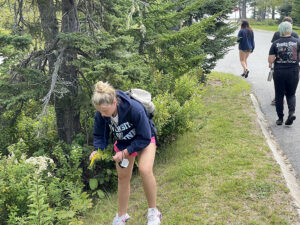
The School of Biology and Ecology welcomes incoming first-year students with an off-campus orientation at the Schoodic Education and Research Center in Acadia National Park on Mount Desert Island. The Schoodic Experience introduces incoming students to the SBE faculty and program in a relaxed and casual atmosphere on Maine’s beautiful coast. While at Schoodic, students participate in faculty-led field activities, explore Schoodic’s facilities and enjoy Mount Desert Island, all while meeting and getting to know other students in the school. More information about facilities, previous trips, and this year’s itinerary can be found here. Registration for the Schoodic Experience ended June 5, 2009. All costs a...(more)
Professor Emeritus George Jacobson delivers keynote address at School of Biology...
His address, titled "Ecological Dynamics in a Changing World: Insights from a Career in Paleoecology", offers highlights from Dr. Jacobson’s noteworthy career, mostly spotlighting his recent work on Maine’s Climate Future: An Initial Assessment, published in April. The publication represents the work of seventy-five Maine scientists in response to a request from Governor John Baldacci for an interdisciplinary, Maine-specific climate assessment and a preliminary framework for meeting the challenges a changing climate will pose in the coming century. Dr. Jacobson edited and contributed to the report which includes within its scope impacts of climate change on the Gulf of Maine, freshwater ecosystems, forestry, biodiversity and indigenous populations as well as concerns and opportunities within agriculture and...(more)
Dr. Celia Chen Lectures on Mercury Research
Mercury, due to its toxicity and bioaccumulation in the food web, is of great concern to biologists. Dr. Celia Chen of Dartmouth College studies the transfer of metals from lake water to fish and the impact of food web structure and trophic status on movement. Dr. Chen visited through the School of Biology and Ecology Seminar Series for a discussion of her most recent work in ecotoxicology. Methylmercury, [CH3Hg]+ is a neurotoxin to humans that causes irreversible brain and kidney damage particularly because it permeates placental membrane and can pass the blood-brain barrier. Dr. Chen cites that humans retain 95% of ingested methylmercury, and as bioaccumulation suggests, many other species are implicated in its absorption and biomagnification, and likewise susceptible to its effects. Recent work has shown ...(more)
Tropical Ecology Students Travel to BrazilFor more than ten years, Bill Glanz (SBE), Aram Calhoun (Wildlife Ecology) and Mac Hunter (Wildlife Ecology) have teamed up to offer a Tropical Ecology Field Course, INT 475, during the spring semester. The course, which culminates in a two-week trip during spring break, offers twenty-two students the opportunity to experience the tropical ecosystems and wildlife they’ve studied. Though the course attracts mostly biology and wildlife students, it is open to students from any discipline. The course emphasizes opportunities to view rare and endemic wildlife and behold neotropical ecosystems, but centers around conservation biology with implications for the social sciences. Students witnessed firsthand governmental efforts to develop ecotourism in rural Brazil; they were housed for part of their trip in such accom...(more)
Agricultural Landscapes Past and Present: Dr. Greg Zaro Presents in the SBE Semi...
Dr. Gregory Zaro of the Antropology Department and the Climate Change Institute terms himself a Historical Ecologist based on his interdisciplinary background and interests. He concerns himself with the co-evolution of humans with their environments, particularly in human-manipulated environments. Agricultural sites provide an insightful area of research for Dr. Zaro as a physical intersection of people and environments. In geographies where paleoecology cannot rely on ice cores and lake basins, agricultural sites can serve as a proxy of environmental changes over time.
Summer Volunteer Field Assistant
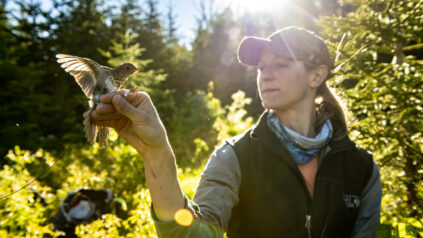
VOLUNTEER FIELD ASSISTANT (1, maybe 2) needed for a Blackpoll warbler research project set in the beautiful White Mountains of New Hampshire. The objectives of this project are to understand the role migratory strategy plays in the ecology and physiology of boreal breeding songbirds (including the Blackpoll) and determining what role migration distance may play in population dynamics. No experience is necessary as all training will be provided. This is a great opportunity to learn songbird identification and observation techniques while gaining hands on field experience. You will become familiar with the daily lives of these elusive birds and ultimately discover their nests. Applicants are recommended to bring their own pair of binoculars (8x42 or 10x42) though a pair may be provided if you do not own any. Applicants are required to have a passion for learning about birds and the natural world, a willingness to work long hours in the field in sometimes difficult conditions, and the patience to observe difficult-to-see species. Housing and some per diem food costs (depending on funding) will be covered by the project. This position may be ideal for undergraduates who are looking for undergraduate research experience if in the University of Maine program (BIO 387-8, 3 credits under the instruction of Dr. Rebecca Holberton) to satisfy a University of Maine Capstone project requirement. Credits can be earned during the summer and applied to the fall semester. The duration of the project is from 1 June through 1 Aug, though the actual start date depends upon snow-melt conditions. Workers would need to commit to at least 8 weeks during this period. Please send any questions about the project, as well as a resume, cover letter, and a list of names and contact information (email and phone number) for 3 people willing to serve as references to: EVAN ADAMS, Doctoral student, University of Maine, School of Biology and Ecology. Positions will be filled as qualified applications are received.
Graduate Student Research Assistantship Available
Looking for a prospective MS or PhD graduate student to join a team of researchers investigating genetic diversity and reproductive ecology of Vaccinium angustifolium (lowbush blueberry) in either wild or managed landscapes. Botany or genetics background preferred but not required. Candidates should also have an interest in ecology as this study will also investigate spatial population genetic patterns and their implications in regard to bee pollinators. The stipend is a 12-month research fellowship ($ 22,000) renewed annually based upon student progress. Please contact Dr. Frank Drummond in the School of Biology and Ecology (frank.drummond@umit.maine.edu) for more information.
Graduate Student Research Assistantship
Looking for a prospective MS or PhD graduate student to join a team of researchers investigating landscape characteristics of lowbush blueberry production and their effects on native pollinator abundance and diversity. Entomology, zoology, or ecology background preferred but not required. Candidates should also have an interest in spatial landscape analysis and conservation biology. The stipend is a 12-month research fellowship that covers tuition and cost of living expenses, renewed annually based upon student progress. Please contact Dr. Frank Drummond in the School of Biology and Ecology (frank.drummond@umit.maine.edu) for more information.
Graduate Student Research Assistantship
Looking for a prospective MS or PhD graduate student to join a team of researchers investigating management practices in lowbush blueberry production and their effects on insect pest abundance, yield loss, and natural enemy abundance and diversity. Entomology, zoology, or ecology background preferred but not required. Candidates should have an interest in applied entomology and modeling. The stipend is a 12-month research fellowship that covers tuition and cost of living expenses, renewed annually based upon student progress. Please contact Dr. Frank Drummond in the School of Biology and Ecology (frank.drummond@umit.maine.edu) for more information.
SMS Student Research Assistant
Are you an undergraduate looking for field experience? We are looking for help collecting trap shrimp by-catch data this winter. The assistant will go shrimping on small trap boats approximately two days a week from mid January-April. The research student will work approximately 20 hours a week during the season and about 5 hours a week for the rest of the spring semester. This position may be split between two students and could include capstone possibilities. Qualifications:Must have reliable transportation and be willing to drive in the early mornings Must be comfortable working on small boats Must be willing to work in winter weather Must have a flexible schedule and be available at least two weekdays Must be reliable, self motivated, and willing to learn Must be independent and a team worker Must have excellent verbal and written communication skills To apply, send resume, cover letter, and the names of two references to: Cinamon Moffet University of Maine School of Marine Science 216 Libby Hall Orono, ME 04469 cinmoffet@yahoo.com 207.581.4259 Applications due by November 20, 2009. Pay will be an hourly rate based on experience.
|
|||||||
|
||||||||
|
||||||||


